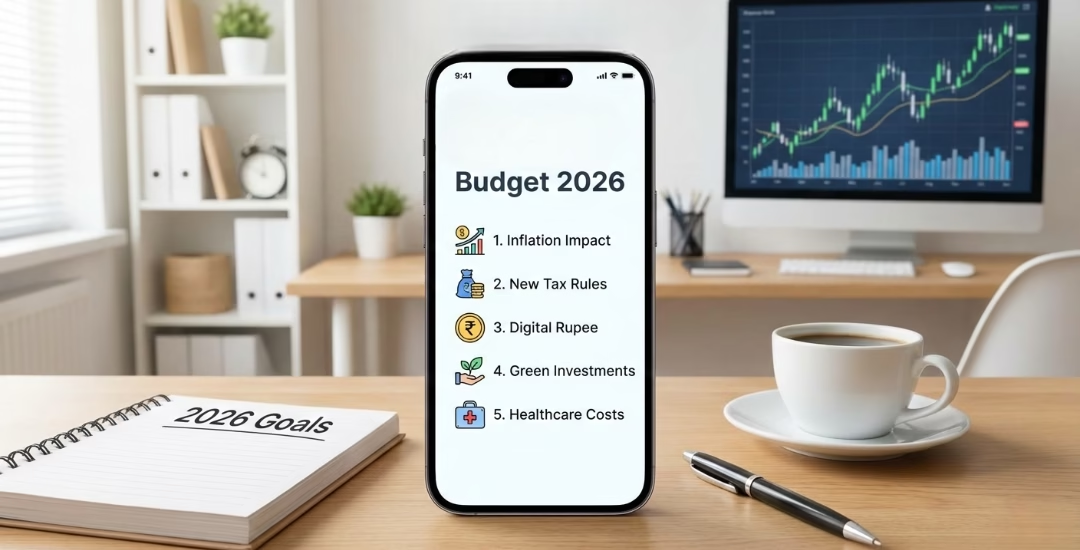
Budget 2026 dropped a lot of announcements. Most of them don’t affect your daily life. But these 5 do — and tracking them could save you thousands this year.
1. Add a “Tax Savings” label (April onwards)
When: April 2026 (new financial year starts)
What changed: Budget 2026 extended the due date for filing revised returns to March 31st, and made procedural changes around TCS rates — particularly reducing TCS on overseas education and medical remittances from 5% to 2%. For many people, especially those sending money abroad for education or medical treatment, this is real savings starting April.
Why it matters to you: If you’re sending money for a family member’s education or medical treatment abroad, you were paying 5% TCS earlier. Now it’s 2%. That’s actual money staying in your pocket — but only if you notice it.
And even for salaried people, small procedural wins like these add up quietly. The problem? Extra money that appears in your account without a clear label has a sneaky habit of just… disappearing.
How to track it in Expenzey:
- Note your current monthly take-home or outgoing amounts (especially remittances)
- From April, calculate the difference after TCS changes kick in
- Track it as a label: “Tax Savings”
- Then decide consciously: save it, invest it, or spend it — but at least you’ll know
Reality check: Even ₹2,000-3,000 saved per month feels small in the moment. But ₹24,000-36,000 over a year? That’s a weekend getaway. An emergency fund boost. Or, if you’re not tracking… 40 food delivery orders you won’t remember ordering. Your choice. But make it a conscious choice.
2. Track gold and jewelry purchases separately (prices are shifting)
When: Anytime you’re planning to buy gold — especially now
What changed: Budget 2026 made changes around customs duty structures and import policies, including tightening exemptions on goods manufactured domestically. Gold and precious metals are directly in this crossfire. Import duty adjustments mean gold prices are expected to shift in the coming months — and when they do, jewelers won’t always be upfront about why prices changed.
Why it matters to you: If you’re planning a wedding, a festival purchase, or even a small investment in gold, prices are about to become less predictable. Buying without tracking means you’re flying blind — and when someone says “gold is expensive right now,” you won’t know if your purchases were actually fair.
How to track it in Expenzey:
- Create a label: “Gold / Jewelry”
- Every time you buy — note the date, weight in grams, and price per gram
- Track over time to build your own personal price history
- Compare before and after duty changes to see real impact
Pro tip: Planning a wedding? Gold is usually the single biggest expense — often bigger than the venue or catering combined. But most people mix it in with “wedding expenses” and lose track of the real number. Track gold purchases separately. When you see ₹2 lakhs sitting under one label, it hits differently than when it’s buried under “Misc – Wedding.”
Also: if you’re buying in installments (like many jewelers offer), track each installment separately. The total only becomes visible when you put it all in one place.
3. Split your medical expenses into smaller labels
When: Start now — don’t wait
What changed: Budget 2026 announced expanded coverage under government health schemes and made specific changes around medical remittance TCS rates. The intent is to make healthcare more accessible. But here’s the ground reality: even when medicines or treatments get slightly cheaper, the surrounding costs — doctor visits, lab tests, hospital charges, transport to the hospital — don’t change at all.
Why it matters to you: Most people have a vague idea of what they spend on healthcare. “Oh, we went to the doctor a few times. Maybe ₹5,000?” In reality, when you add up medicines, consultations, tests, emergency visits, and transport — the number is almost always 2-3x what people guess.
And when tax filing or insurance claim time comes, “I spent some amount on medical stuff” won’t cut it. You need records. Clean, sorted ones.
How to track it in Expenzey: Instead of one generic “Medical” label, split it into:
- “Medical – Medicines” (pharmacy purchases, online medicine orders)
- “Medical – Consultation” (doctor visits, specialist fees)
- “Medical – Tests / Scans” (lab work, imaging, blood tests)
- “Medical – Emergency” (unplanned hospital visits, urgent care)
Why this matters beyond tracking: Insurance companies ask for breakdowns, not lump sums. Tax deductions under Section 80D require documentation. And honestly — when you see “Medical – Tests” at ₹8,000 for a single month, it forces a conversation about whether all those tests were truly necessary, or if some were redundant.
This isn’t about cutting corners on health. It’s about knowing what you’re spending, so you can make informed decisions.
4. Track your next phone or laptop purchase — with price notes
When: If you’re planning to buy electronics in the next 3-6 months
What changed: Budget 2026 increased the Electronics Components Manufacturing Scheme outlay to ₹40,000 crore and made changes to customs duties on various goods. The government’s push is to make electronics manufacturing cheaper domestically. In theory, this should bring prices down over time.
In theory.
Why it matters to you: “Budget reduced duty on components” does NOT automatically mean “the phone you want just got cheaper.” Manufacturers and retailers take time to pass on savings — sometimes months. Sometimes they pocket the margin entirely. The only way to know if prices actually dropped? Track them yourself.
How to track it in Expenzey:
- See a phone or laptop you want? Log its price today — even if you’re not buying yet. Use the label: “Electronics – Price Watch”
- Check the same model again in 4-6 weeks
- When you actually buy, log it under “Electronics – Purchase”
- Compare: Did the price actually drop after the budget changes?
Real talk: This isn’t just about one purchase. It’s about building a habit. Every time you window-shop something expensive, log the price. Over months, you’ll see patterns — when prices actually dip, which brands pass on savings, and which don’t. That’s data. And data beats guesswork every single time.
Bonus: If you bought something at a higher price before the duty cut and the price drops later — you’ll know you overpaid. No guessing. No “I think it got cheaper.” Just facts.
5. If your parents now qualify for a government health scheme, track what you’re saving
When: Check eligibility first. Then start tracking immediately.
What changed: Budget 2026 expanded coverage and accessibility of government health schemes, with a focus on making healthcare reachable for more families. If your parents (or any family member) now fall under an expanded scheme, their treatment could be covered — partially or fully — by the government.
Why it matters to you: For millions of people, parents’ healthcare is one of the biggest unexpected expenses. One hospital admission can cost ₹50,000-2,00,000+. If a government scheme now covers even a portion of that, it’s not just relief — it’s real money freed up in your budget.
But here’s what most people do: they feel relieved, and the “saved” money quietly gets absorbed into other spending without anyone noticing. It just disappears into the general flow of life.
How to track it in Expenzey:
- First, estimate what you were spending (or would have spent) on your parents’ healthcare annually
- Create a label: “Savings – Parents Healthcare”
- Every time a treatment or consultation is covered by the scheme, log what it would have cost you
- At the end of the month, you’ll see a clear number: “This is how much the scheme saved us”
Why track savings, not just expenses? Because invisible savings disappear. When you see ₹15,000 under “Savings – Parents Healthcare” at the end of a month, you have a choice: put that into an emergency fund, redirect it to your own goals, or invest it. But if you never tracked it, you’d never even know that money existed.
It’s like finding ₹15,000 in your jacket pocket — except it happens every month, and you can plan for it.
The bigger picture
Budget 2026 changed a lot of things. Most of it won’t directly touch your daily life. But the changes that do matter? They’re quiet. They don’t announce themselves in your bank statement.
That’s why tracking matters more than ever after a budget — not to become a finance expert, but to stay aware of where your money is going and where it’s coming from.
These 5 labels in Expenzey won’t take you more than 5 minutes to set up. But over the next few months, they’ll give you clarity that no budget speech ever will.
Your money. Your data. Your awareness.
Quick-start checklist
Set up these labels in Expenzey today:
- ✅ Tax Savings
- ✅ Gold / Jewelry
- ✅ Medical – Medicines
- ✅ Medical – Consultation
- ✅ Medical – Tests / Scans
- ✅ Medical – Emergency
- ✅ Electronics – Price Watch
- ✅ Electronics – Purchase
- ✅ Savings – Parents Healthcare
Takes 2 minutes. Saves you from guessing for the rest of the year.
References
Budget 2026 Key Points – India Budget
Budget 2026 Highlights – ClearTax
Budget 2026 Speech – India Budget