

January 1st. New year, new you. This time you’re really going to track your expenses.
You download an app. It looks promising. Clean interface. Good reviews. “5-star rated expense tracker!” the description says.
- Day 1: You log everything. Coffee. Lunch. Uber. You feel responsible. Adult. In control.
- Day 3: Still going strong. The app sends you a notification. “Great job tracking!” You feel motivated.
- Day 7: You forgot to log yesterday’s expenses. No big deal. You try to remember. Was that ₹450 or ₹550 for groceries? You guess.
- Day 10: The app is asking you to set a budget. Categories. Monthly limits. Subcategories. You’ll do it later.
- Day 14: You haven’t opened it in 3 days. There’s a red badge showing “12 unsynced transactions.” You feel guilty. You ignore it.
- Day 21: The app is on page 3 now, buried between apps you forgot you downloaded.
Sound familiar?
You’re not lazy. You’re not bad with money. The app just wasn’t built for how humans actually behave.
The 5 reasons expense trackers fail (and why nobody talks about them)
1. They demand perfection from day one
Most apps treat expense tracking like accounting. Every transaction. Every category. Every receipt. From day one.
That’s not tracking. That’s a part-time job.
The problem: You’re not an accountant. You’re a person trying to understand where your money goes. Starting with “log every ₹10 expense perfectly” is like starting a fitness journey with “run a marathon tomorrow.”
What happens: You miss one day. Then two. The gap grows. Guilt builds. You give up.
What actually works: Start small. Track only big expenses first. ₹500+. That’s it. You’ll catch 80% of your spending with 20% of the effort. Once that becomes a habit, expand.
Expenzey doesn’t force categories or budgets on day one. You just log what you spent. That’s it. The habit comes first. The insights come later.
2. They automate the wrong thing
“Link your bank account! We’ll track everything automatically!”
Sounds great. In theory.
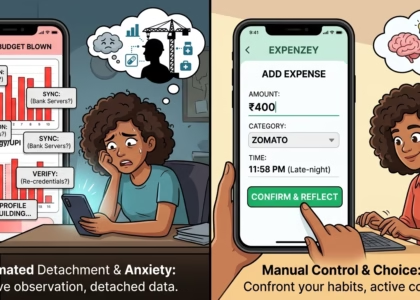
The problem: Automatic tracking removes the one thing that actually changes behavior — awareness.
When your app silently logs “₹180 – Swiggy” in the background, you never actually think about that expense. It’s just data. Numbers in a database.
But when you manually log “₹180 – Food Delivery – Lazy Sunday dinner I didn’t need,” you feel it. You notice the pattern. You question it.
The psychology: The act of logging is where the change happens. Automation skips that step.
What actually works: Manual tracking for things that matter. Not every ₹10 expense. Just the ones that add up.
According to behavioral finance research, people who manually log expenses reduce unnecessary spending by 15-20% — not because they set strict budgets, but because they become aware.
You can’t change what you don’t notice. Automation makes you blind.
3. They punish you with complexity
Open most expense apps and you’re immediately hit with:
- “Set up your budget!”
- “Choose categories!”
- “Link your bank!”
- “Invite family members!”
- “Set financial goals!”
It’s overwhelming. And overwhelming things don’t get done.
The problem: You just want to know where your money went. But the app wants you to become a financial planner on day one.
What happens: Decision fatigue. You close the app. You’ll “set it up properly later.” Later never comes.
What actually works: Start with one thing. Just one. Log an expense. That’s it. No categories. No budgets. No 15-step onboarding.
Expenzey lets you add an expense in 5 seconds. Amount. Label (if you want). Done. That’s the entire flow. The rest is optional. Because optional features don’t block progress.
4. They ignore the reality of irregular spending
Most apps assume you spend the same amount every month. Neat categories. Predictable patterns. Monthly budgets.
Real life doesn’t work that way.
Some months you have a wedding. Some months your laptop breaks. Some months you travel. Some months are quiet.
The problem: When apps expect consistency and you give them chaos, they break. Your “budget” shows red. Notifications scold you. You feel like you failed.
What happens: You stop opening the app because it makes you feel bad.
What actually works: Track reality, not ideals. Some months are expensive. That’s fine. The goal isn’t to spend the same every month. The goal is to know what you spent and why.
Expenzey shows you what happened. Not what should have happened. No judgment. No red warnings. Just data.
5. They make you wait for insights
You’ve been tracking for 10 days. You open the app. You want to see patterns. Trends. Something useful.
Instead, you see:
- “Not enough data yet”
- “Track for 30 days to see insights”
- “Upgrade to premium for analytics”
The problem: Delayed gratification doesn’t work for new habits. You need quick wins. Immediate feedback. Something that shows progress today, not in 30 days.
What happens: You don’t see value fast enough. So you stop using it.
What actually works: Instant feedback. Even if it’s simple. “You spent ₹890 today. That’s more than yesterday (₹450).” That’s insight. That’s useful. Day one.
You don’t need complex AI analysis. You need to notice patterns yourself. And you can’t notice patterns if the app hides data behind “coming soon” screens.
The real reason apps fail: They’re built for finance nerds, not normal people
Most expense trackers are built by people who love spreadsheets. Who enjoy budgeting. Who track every ₹5 expense because it’s satisfying.
But that’s not you. That’s not most people.
Most people:
- Don’t have time for complicated budgets
- Don’t want to link bank accounts
- Don’t care about 47 different categories
- Just want to know: “Where did my money go this month?”
And when an app demands perfection, punishes you for missing days, and hides insights behind paywalls — you quit.
Not because you’re lazy. Because the app wasn’t designed for humans.
What actually works: The simple system
Here’s a system that actually sticks:
Week 1: Track only expenses over ₹500. That’s it. No categories. No budgets. Just log the big ones.
Week 2: Add one small habit — track food delivery orders. Every single one. See the pattern emerge.
Week 3: Label your expenses. Simple labels. “Food Delivery.” “Shopping.” “Transport.” Whatever makes sense to you.
Week 4: Review. Look back at the month. Not to judge yourself. Just to notice. “Huh. I spent ₹8,000 on food delivery. Didn’t realize it was that much.”
That’s it. That’s the system.
No budgets (unless you want them). No linking bank accounts (unless you want to). No overwhelming setup. Just awareness.
And awareness changes behavior faster than any budget ever will.
Why Expenzey was built differently
I built Expenzey because I failed at expense tracking. Multiple times. With multiple apps.
Every app wanted me to become a financial analyst. I just wanted to know where my ₹50,000 salary went every month.
So I built something different:
5-second expense entry. Amount. Optional label. Done. No forced categories. No 10-step flow.
Your labels, your way. “Weekend Splurge.” “Stress Shopping.” “Didn’t Need This.” Whatever makes sense to you. Not preset categories that never quite fit.
Local-first. Data stays on your phone. No cloud sync by default. No bank linking. Privacy isn’t a premium feature.
No judgment. The app shows you what you spent. Not what you should have spent. No red warnings. No “You’re over budget!” guilt trips.
Instant feedback. Day one, you see your daily total. Week one, you see weekly patterns. Month one, you see monthly trends. No “track for 30 days first” gates.
It’s not the most feature-rich app. It’s not trying to be. It’s trying to be the one you actually use after 2 weeks.
The uncomfortable truth
Most expense tracking apps fail because they’re designed to be comprehensive, not useful.
They want to track everything. Categorize everything. Analyze everything. Optimize everything.
But everything is the enemy of something.
You don’t need to track every ₹10 chai. You need to notice that you spent ₹6,000 on food delivery this month. That’s the insight that changes behavior.
You don’t need 47 budget categories. You need to see “I spent ₹15,000 on things labeled ‘Impulse Buy.'” That’s the wake-up call.
The best expense tracker isn’t the one with the most features. It’s the one you still use in week 3.
Start simple. Stay consistent.
If you’ve failed at expense tracking before, it’s not your fault. The apps weren’t built for you.
But here’s the good news: tracking doesn’t have to be complicated. It doesn’t have to be perfect. It just has to happen.
Start with one thing. Track your big expenses this week. Just the big ones. See how it feels.
If you want a tool that makes this easy, try Expenzey, no login required, no setup friction, no forced budgets, no data uploaded to clouds.
Built by someone who failed at expense tracking. For people who failed at expense tracking.



Bu güzel bilgilendirmeler için teşekkür ederim.
For the reason that the admin of this site is working, no uncertainty very quickly it will be renowned, due to its quality contents.