
Most expense trackers treat every transaction as a finished event:
You spend money.
The expense is recorded.
The story ends.
But real life is often more complicated.
You may pay for dinner and expect a friend to return their share. You might purchase something that will be reimbursed by your employer. Or you may be waiting for a refund from a merchant.
The payment has happened—but the transaction is not financially complete.
That is why we created Open Items in Expenzey.
The problem with ordinary expense tracking
Imagine you pay ₹2,000 for dinner and a friend promises to return ₹1,000.
A traditional expense tracker records: Dinner · ₹2,000 · Food
That record is correct, but it misses something important: part of the money is expected back.
You could add a note, create a reminder or maintain a separate list. But none of those approaches connects the pending money to the original expense. After a few days, it becomes easy to forget:
- Who still needs to repay you?
- Which refunds have not arrived?
- Which work expenses are awaiting reimbursement?
- How much money are you expecting back in total?
Some apps solve this with separate lending, debt or reimbursement modules. These can be useful, but they also ask you to maintain another financial system alongside your transactions.
We wanted something lighter.
Introducing Open Items
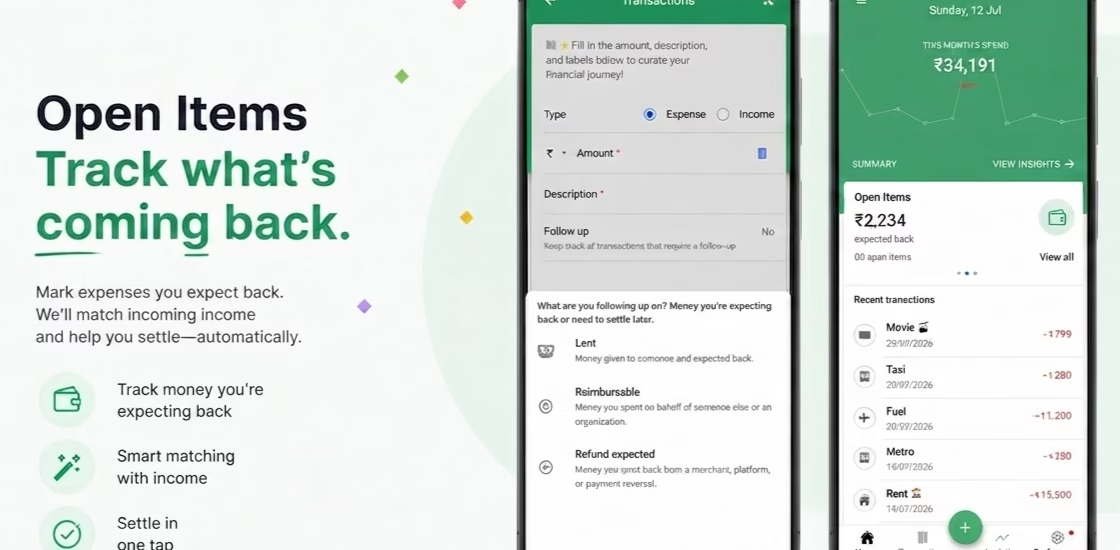
When adding an expense in Expenzey, you can optionally mark it for follow-up as:
- Lent
- Refund expected
- Reimbursable
The transaction continues to behave like a normal expense. It keeps its amount, account, date and labels.
Expenzey simply remembers that its financial story is not finished yet.
The item then appears under Open Items, where you can see how much money you are still expecting back.
There is no separate lending ledger to maintain and no duplicate entry to create.
How it works
Suppose you pay ₹1,200 for a friend’s ticket.
While recording the expense, choose:
- Follow up → Lent
- Expenzey adds it to Open Items:
- ₹1,200 expected back
- Ticket · Lent · Open
- A few days later, your friend returns the money. You record the ₹1,200 as a normal income transaction.
- Expenzey checks whether it matches anything you are waiting for and suggests Looks like this settles an open item.
- Confirm the match and the item changes from Open to Settled.
The original expense and returned income remain intact, while Expenzey preserves the connection between them.
One simple lifecycle
Every Open Item follows a straightforward journey:
Expense → Follow up → Open → Money returned → Settled
The same flow works across several everyday situations.
Money lent
You pay for someone and expect their share back.
- Dinner · ₹800
- Lent · Open
When the money returns, Expenzey helps connect the income and settle the item.
Refund expected
You return a product and are waiting for the merchant to process the refund.
- Headphones · ₹3,499
- Refund expected · Open
The item stays visible until the refund arrives.
Reimbursable expense
You pay for travel or supplies that your employer will repay.
- Office cab · ₹650
- Reimbursable · Open
You can see it alongside your other pending reimbursements instead of maintaining a separate spreadsheet.
Designed to stay out of your way
We deliberately kept Open Items subtle.
Most expenses do not need a lifecycle, so Expenzey does not force you to classify every transaction or complete extra fields.
You will not be asked to create a separate loan, switch to another ledger or maintain a parallel record. The option appears inside the transaction flow only when you need it.
On the Home screen, a compact summary shows:
Open Items
₹4,149 expected back
3 open items
Tap it to review what is still unresolved. Once everything is settled, there is nothing else to manage.
Transactions with a beginning and an ending
Open Items are not meant to turn Expenzey into debt-management or accounting software.
They solve a smaller, familiar problem:
Some money leaves temporarily and you should not have to remember all of it yourself.
By connecting the original expense with the money that eventually comes back, Expenzey gives those transactions a proper ending.
No separate ledger.
No duplicate bookkeeping.
Just a subtle way to keep track of money until the story is settled.


This post delivered a refreshing way to understand the issue during my research and I look forward to reading more from you
This post delivered a clear perspective on the topic when I needed it most and I look forward to reading more from you
Your post offered practical information I can use this morning and I look forward to reading more from you