
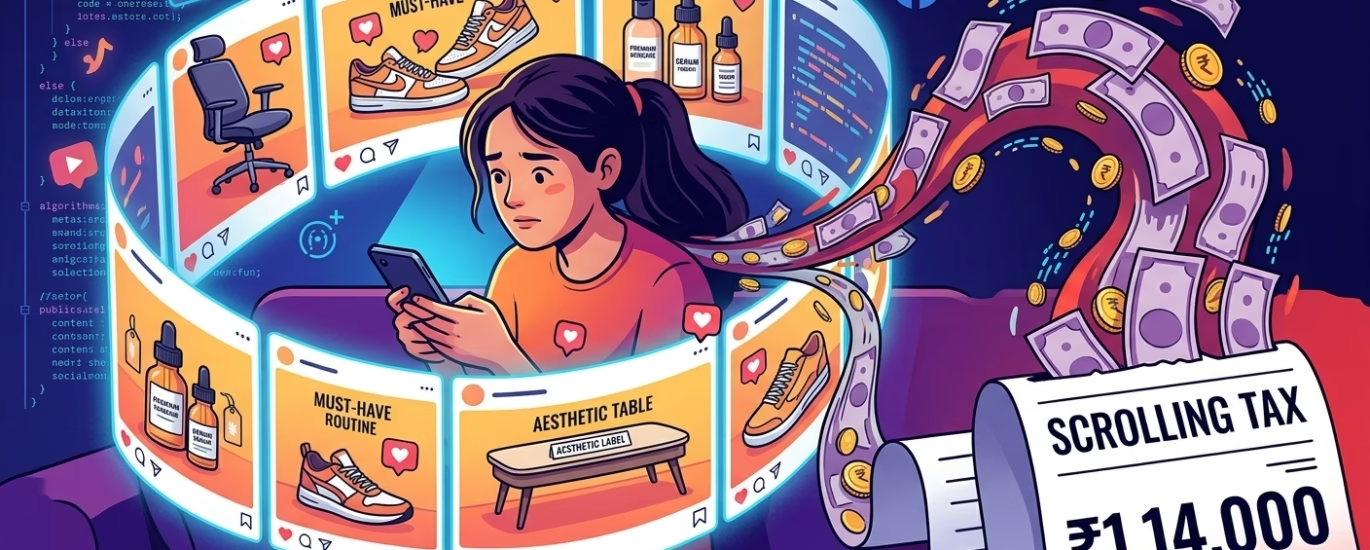
I recently sat down to reconcile my bank statements from the last few months, and honestly, the number caught me off guard. It wasn’t my rent or my utility bills that did the damage. It was the “scrolling tax.” After adding up every spontaneous purchase influenced by an Instagram ad or a creator’s recommendation, I hit a total of ₹1,14,000 for the year so far.
That number felt heavy. It wasn’t a sudden emergency or a planned investment. It was a collection of aesthetic coffee tables, “must-have” sneakers, and skincare routines that promised to fix problems I didn’t know I had.
If you’ve ever felt like your bank balance is bleeding out in small, silent increments, you aren’t alone. Here is how I realized where my money was going and how I started fixing it.
The trap of the algorithm
Instagram is essentially a high-speed shopping mall designed specifically for your personality. The algorithm knows I like minimalism, so it shows me ergonomic chairs. It knows I value self-care, so it serves me trending serums.
The problem isn’t that these products are bad. The problem is the friction-free nature of the purchase. A targeted ad, one tap on a website, and a quick UPI payment mean the money leaves your account before your brain can even ask, “do I actually need this?”
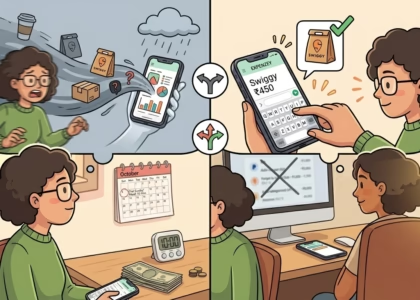
I started tracking my spending manually in Expenzey because I realized that automated alerts were too late. By the time I got a notification that I had spent money, the money was already gone. Manual entry forced me to pause for those five seconds, which is often enough time to realize that the viral sneakers are just another pair of shoes.
The aesthetic home decor delusion
My biggest expense this year was home decor. I spent ₹42,000 on items that looked incredible on my feed but were largely impractical. I bought an aesthetic wooden table because it matched the lighting in a reel I saw, even though my existing table was perfectly functional.
We are often sold an aesthetic rather than a product. When you buy that “Instagram-perfect” lamp, you aren’t just buying light—you are buying a feeling of having your life together. But once the package arrives and the excitement of the unboxing fades, you are left with a piece of furniture that takes up space and a lighter wallet.
The skincare spiral
Then there was the skincare. I found myself buying a new trending moisturizer every time a creator mentioned it was “life-changing.” I spent nearly ₹28,000 on products that mostly ended up collecting dust because my skin didn’t actually need them.
The psychology here is subtle. It’s called “social proof.” If five people I follow are using the same cream, my brain assumes it’s a standard I should meet. Tracking these expenses allowed me to see the pattern. Seeing the sum total of those small, “harmless” transactions in one place made it impossible to ignore the waste.
Why manual tracking changes the game
Most people use apps that pull data from their SMS or bank accounts. While convenient, this creates distance between you and your money. It’s easy to ignore a digital report generated by an algorithm.
When you track manually using a tool like Expenzey, you acknowledge every transaction. You label them yourself. When I had to label my spending as “impulse buy” or “influenced by social media” instead of just “shopping,” the shame—and the awareness—hit home.
It wasn’t about being restrictive or cutting out all joy. It was about realizing that I was paying a heavy price for momentary dopamine hits.
Finding the balance
I haven’t deleted Instagram, and I haven’t sworn off buying things I like. However, I’ve introduced a 48-hour rule. If I see something on an ad that I want, I save the link and wait two days. If I still want it after 48 hours, I check my Expenzey dashboard to see if I have the “room” in my budget for it.
Nine times out of ten, the urge disappears. The “must-have” product loses its luster once the algorithm stops showing it to me every ten minutes.
The real cost of convenience
We often blame inflation or rising costs for why we can’t save. While those are real factors, they don’t account for the quiet leak caused by digital consumption. That ₹1,14,000 didn’t go toward rent, savings, or travel—it went toward things that provided zero long-term value.
Being honest with myself about this figure was the best thing I could have done. It wasn’t a pleasant discovery, but it was a necessary one. You don’t need a complex financial plan to fix this; you just need to stop letting the apps decide what your money is worth.
Take a look at your bank statements from the last three months. Filter for the brands you saw on social media. You might be shocked at the total. But once you see it, you can’t unsee it—and that’s exactly where your financial control begins.


Your explanation gave me a thoughtful explanation of the subject during my research and I look forward to reading more from you