

As a software engineer, I’ve used multiple expense tracking apps over the years.
Most of them started out useful. But eventually I found myself dealing with intrusive ads, premium restrictions, and features that felt designed to monetize rather than help.
The final trigger came when an app I had been using for over a year suddenly required a subscription just to export my own data. I had spent months building my expense history inside the app, and now accessing it felt like a paid feature.
That experience left me with a simple question:
Why should tracking personal finances require giving up control over your own data?
That’s how Expenzey started.
The Problem I Wanted to Solve
- The issue wasn’t just ads or subscriptions.
- I also struggled with how traditional expense trackers organized information.
- Most apps force every expense into a single category.
But that’s not how I think about money. Imagine attending a family function.
- You spend money on food, transportation, gifts, and decorations.
- Should the food expense go under “Food” or “Family Function”?
- If I choose Food, it gets mixed with all my regular meals.
- If I choose Family Function, I lose visibility into my food spending.
Neither option felt right.
As a user, I wanted to organize expenses the way I naturally think about them.
That’s when I realized labels could solve this problem.
Instead of forcing users into rigid category hierarchies, a single expense could have multiple labels:
🎉 Family Function + 🍕 Food
💼 Work + ☕ Coffee
🏝 Vacation + ✈️ Travel
This makes it easier to answer real-life questions like:
- How much did my family function cost?
- How much do I spend on work-related meals?
- What was the total cost of my vacation?
Without forcing users to maintain complicated category structures.
Building Expenzey
I released the first version of Expenzey in January 2025.
Initially, it was a simple expense tracker built primarily for my own use. I used the app daily, continuously refining the experience and removing friction wherever possible. From day one, I wanted Expenzey to be:
- Privacy-first
- Local-first
- No signup required
- No unnecessary permissions
- Simple enough to use every day
The goal was straightforward:
Users should think about tracking expenses, not managing accounts or worrying about where their data goes.
The unexpected setback
A few weeks after launch, I received a notice from Google Play stating that Expenzey had been removed due to policy violations.
This came as a complete surprise.
The app requested very few permissions and had been designed with privacy as a core principle.
What followed was months of appeals, explanations, and discussions with the Google Play team. Despite multiple attempts, I was unable to immediately get the app reinstated. Losing access to the primary Android distribution channel was frustrating.
But it also forced me to think differently.
Finding alternative distribution
With Google Play unavailable, I started exploring alternative ways to distribute Expenzey. I published the app on other Android marketplaces and also offered direct APK downloads through the Expenzey website.
The growth was slow.
But it was real.
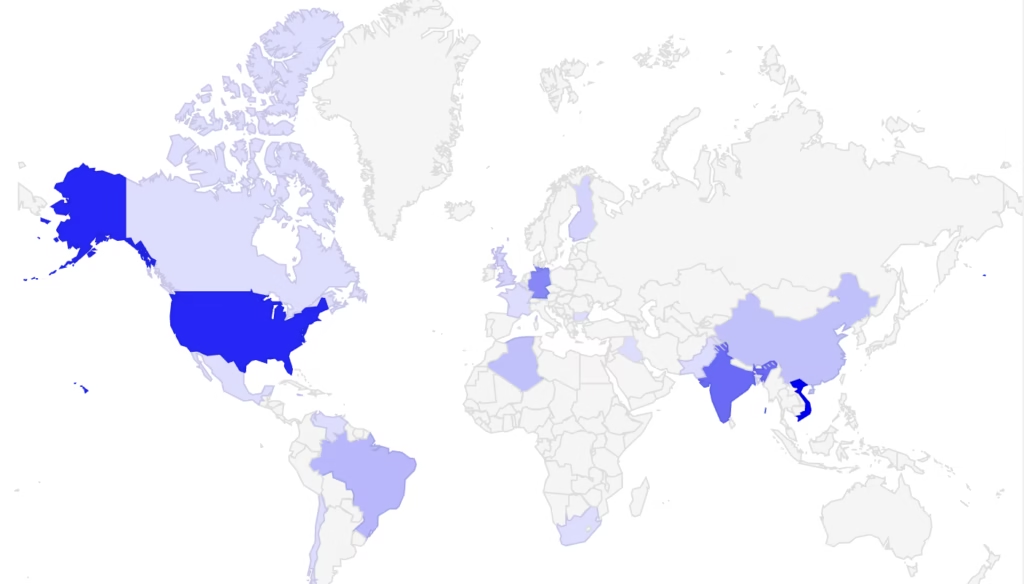
Over the following months, users downloaded the app directly from countries including the United States, United Kingdom and Germany.
Seeing people from around the world discover and use something I had built was incredibly motivating.
During this period, I also began sharing updates through founder communities, launch platforms, and LinkedIn.
One of those platforms was Aura++.
Why I Launched on Aura++
I launched Expenzey on Aura++ in October 2025.
- At the time, I was actively looking for places where builders could discover products from other builders.
- The submission process was straightforward and the platform felt thoughtfully designed.
- Unlike larger platforms where products can easily disappear into the noise, Aura++ felt curated and founder-focused.
- The launch generated useful feedback and helped introduce Expenzey to a community that genuinely enjoys exploring new products.
- One unexpected highlight was seeing Expenzey become the #1 Product of the day on the platform.
While the launch itself wasn’t massive in terms of raw numbers, it provided something equally valuable:
Validation.
For a product recovering from a Play Store suspension and rebuilding its distribution channels, that validation mattered.
Returning to Google Play
After continued communication and providing additional information, Expenzey was eventually reinstated on Google Play.
Getting the app back felt like a major milestone.
It wasn’t just about downloads. It was proof that persistence matters.
Since returning, Expenzey has crossed:
- 200+ total downloads across all channels
- 60+ Google Play downloads
- Users across multiple countries
- Growing engagement from founders and early adopters
The website has also seen encouraging traction, with nearly 90 active users and over 1,200 tracked events during a recent month.
Building in Public
One habit that helped throughout the journey was maintaining a public changelog.
Every feature, improvement, and experiment was documented openly.
This served two purposes:
- It kept me accountable.
- It allowed other builders to see how the product evolved over time.
Building in public doesn’t require a large audience.
Sometimes it simply means showing up consistently and sharing progress.
Lessons Learned
A few lessons stand out from the journey so far.
Distribution matters as much as product
Building something useful is only half the challenge.
People still need a way to discover it.
Constraints create opportunities
Losing Google Play temporarily forced me to explore alternative channels and communities I otherwise may have ignored.
Validation comes in many forms
Not every win is measured by downloads.
Sometimes a thoughtful piece of feedback, a founder conversation, or a returning user is enough motivation to keep going.
Labels solved a real problem
When I started building Expenzey’s label-based approach, it felt unconventional.
Since then, I’ve noticed more products exploring similar ideas. That’s encouraging because it validates the underlying problem.
People don’t naturally think in categories, they think in contexts.
What’s Next
Today I’m continuing to build Expenzey as a solo founder alongside a full-time engineering role and the adventure of being a new parent. In fact, the first version of Expenzey Pro was released during the early weeks of parenthood.
The next phase focuses on making financial insights more accessible.
With Expenzey Pro, users can already explore their data through a conversational interface, and we’re continuing to expand smart insights that help people understand spending patterns without digging through reports.
The long-term goal remains unchanged:
Build an expense tracker that respects user privacy, avoids unnecessary complexity, and helps people make better financial decisions without compromising on trust.
And yes, there are a few exciting features currently in development that might make budgeting feel a lot more natural.
Final Thoughts
Launching on Aura++ and other product platforms was one meaningful part of the Expenzey journey.
The platform helped expose the product to fellow builders, generated valuable feedback, and provided momentum during a period when distribution was particularly challenging.
- For founders considering where to launch their products, my advice is simple:
- Don’t focus only on traffic.Focus on communities where people genuinely care about what you’re building.Those conversations often become more valuable than the numbers.


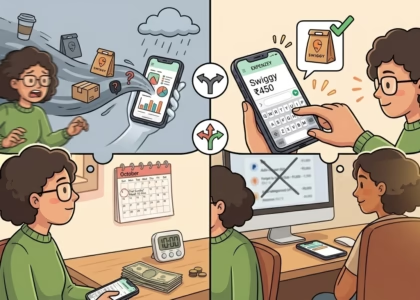
Featured post on aura++ – https://auraplusplus.com/case-study/expenzey-play-store-to-product-of-the-day