

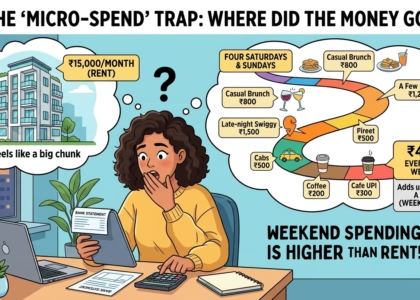
Ever feel like your salary vanishes into thin air? You get paid, you pay your bills, and then suddenly it’s mid-month, and you’re wondering where all that money went. It’s a common feeling, and it’s often due to what we can call ‘silent leaks’ in our budget. These aren’t the big, obvious expenses like rent or your loan EMIs. They’re the smaller, often unnoticed drains that add up significantly over time.
This isn’t about guilt. It’s about awareness. Think of it like this: you wouldn’t leave a tap running unattended, right? Silent leaks are the financial equivalent of that. Let’s talk about how to spot them and plug them.
The subscriptions you forgot about
We live in an age of convenience, and subscriptions are a big part of that. Streaming services, cloud storage, news apps, gym memberships, software licenses – the list goes on. It’s easy to sign up for something that seems useful, only to forget about it a few months later.
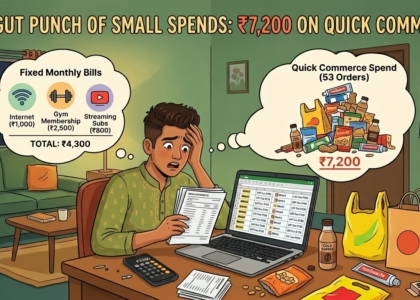
Have you ever scrolled through your bank statement and seen a recurring ₹199 charge you don’t recognise? That’s a classic silent leak. The initial cost might be small, but multiply that by a few forgotten subscriptions, and it can easily add up to ₹1,000 or more each month. And if you’re subscribed to multiple services you barely use, the cumulative effect is even bigger. It’s not about cutting out all subscriptions, but about being mindful of what you’re actually using and paying for.
The daily impulse purchases
That ₹50 coffee on your way to work? The ₹100 snack from Swiggy you didn’t really need? The extra ₹200 gadget you saw online and just “had to have”? These small, often impulsive purchases are the notorious silent leakers.
Individually, they seem insignificant. But consider this: if you buy a coffee every working day for ₹50, that’s ₹1,000 a month. Add a few ₹100 impulse buys a week, and you’re looking at another ₹400-₹500. Suddenly, your daily coffee habit and occasional online browsing are costing you ₹1,500 a month that you might not have even realised you were spending. These purchases often happen without much thought, making them incredibly sneaky.
Those ‘just in case’ purchases
Sometimes we buy things ‘just in case’ we might need them. Maybe it’s an extra set of kitchen utensils, a new piece of clothing for an event that might happen, or a gadget that seems like a good idea at the time. The intention is usually good – to be prepared.
However, many of these ‘just in case’ items end up sitting unused in a cupboard or drawer. They represent money that has been spent and is now essentially gone, without providing any real ongoing value. This isn’t about never buying anything new; it’s about distinguishing between needs, genuine wants, and speculative purchases that drain your funds without much return.
The hidden costs of convenience
We often pay a premium for convenience. Ordering food online instead of cooking, taking a cab instead of public transport, or buying pre-cut vegetables all save us time, but they also cost more. A ₹300 Zomato order might feel justified because you’re tired, but if that becomes a regular occurrence instead of a treat, it adds up.
Similarly, opting for a slightly more expensive but faster delivery service, or paying extra for a subscription that promises to “simplify” your life, can be a silent drain. It’s not that these conveniences are inherently bad, but understanding their true cost is crucial. Sometimes, a little bit of planning or effort can save you a significant amount of money without a huge loss in quality of life.
How to spot and plug the leaks
So, how do you actually find these silent leaks and stop them? It starts with awareness. You can’t fix what you don’t see.
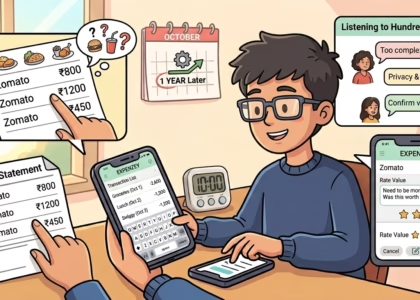
The most effective way is to track your expenses, but not in a way that feels overwhelming. Forget rigid categories for a moment. Instead, focus on simply noting down every amount you spend, no matter how small. This immediate record-keeping forces you to acknowledge each transaction. Did you buy that coffee? Write it down. Did you order from Swiggy? Record it.
This is where a simple, privacy-first app like Expenzey can be incredibly helpful. It’s designed for quick, manual entry, so you can log expenses on the go without sharing sensitive bank details. The act of typing in each amount—₹50 for coffee, ₹250 for lunch, ₹199 for that forgotten subscription—builds a clear picture of your spending habits.
Once you have a few weeks of these entries, you can start to see patterns. You’ll spot those recurring subscription charges you’d forgotten about. You’ll notice how many times you’ve ordered food delivery in a week. You’ll see the cumulative impact of those small impulse buys.
From there, you can make informed decisions. Can you cancel a subscription you never use? Can you plan meals to reduce food delivery orders? Can you set a small daily budget for those impulse buys? It’s about making conscious choices, not drastic sacrifices.
A practical takeaway
Your money is yours, and understanding where it goes is the first step to controlling it. Silent leaks are subtle, but their impact is undeniable. By taking a few minutes each day to track your spending, you gain the power to identify these drains.
Think of Expenzey not as a chore, but as a tool for clarity. It helps you see the full picture without compromising your privacy. Start by just noting down every transaction for a week. You might be surprised at what you discover. Once you see the leaks, plugging them becomes a lot easier, and your financial well-being will thank you for it.
References
– How to track your expenses. Retrieved from https://www.nerdwallet.com/article/finance/how-to-track-expenses
– The best ways to track your expenses. Retrieved from https://www.thebalance.com/how-to-track-expenses-4175167
– The 50/30/20 rule: A guideline for budgeting. Retrieved from https://www.investopedia.com/terms/1/50-30-20-budget-rule.asp


I really like reading through a post that can make men and women think. Also, thank you for allowing me to comment!
Verdiginiz bilgiler için teşekkürler , güzel yazı olmuş
Sitenizin tasarımı da içerikleriniz de harika, özellikle içerikleri adım adım görsellerle desteklemeniz çok başarılı emeğinize sağlık.
Hocam detaylı bir anlatım olmuş eline sağlık
I’m often to blogging and i really appreciate your content. The article has actually peaks my interest. I’m going to bookmark your web site and maintain checking for brand spanking new information.
gerçekten çok yararlı bi konu teşekkürler
I very delighted to find this internet site on bing, just what I was searching for as well saved to fav
This is my first time pay a quick visit at here and i am really happy to read everthing at one place
Pretty! This has been a really wonderful post. Many thanks for providing these details.
Great information shared.. really enjoyed reading this post thank you author for sharing this post .. appreciated